If you’re searching for how to register my dog in Hill County, Texas, the most important thing to know is that “dog registration” is usually handled by the city you live in (if you live inside city limits) rather than through a single countywide program. In Hill County, the process commonly ties back to rabies vaccination compliance and local animal ordinances, which may require a tag or license for dogs kept within city limits.
This page explains the practical steps for getting a dog license in Hill County, Texas, how rabies requirements work statewide, and how to identify the right office to contact for an animal control dog license Hill County, Texas question—without relying on third-party registration services.
Where to Register or License Your Dog in Hill County, Texas
Because rules vary by city, the best answer to where to register a dog in Hill County, Texas depends on your address. Below are example official offices within Hill County that commonly handle licensing, animal control, and rabies enforcement questions. Contact the office that matches your city limits (or the county if you are outside city limits).
Hill County Sheriff’s Office
City of Whitney (City Hall / Animal Registration)
City of Hillsboro (Municipal Office Contact)
Overview of Dog Licensing in Hill County, Texas
What “registering your dog” usually means
In everyday terms, “registering” a dog can mean several different things—so it helps to separate them clearly:
- Dog license / city registration tag: A local (often city-issued) requirement to keep a license or registration current for dogs kept within that city’s limits.
- Rabies vaccination certificate and rabies tag: Proof from a veterinarian that your dog is vaccinated against rabies; this is closely linked to local licensing because many cities require proof of rabies vaccination to issue a license.
- Microchip registration: A private registration tied to a microchip number (not the same as a government dog license).
Why licensing is local in Hill County
A dog license in Hill County, Texas is commonly a municipal requirement when you reside within an incorporated city (for example, within the City of Hillsboro or City of Whitney). Each city may set its own renewal cycle, fees, and documentation rules, and those rules can differ even within the same county. That’s why the best “first step” is to identify which local government has jurisdiction where your dog is kept.
Rabies vaccination is the foundation
Regardless of where you live in Hill County, Texas law requires dogs (and cats) meeting the applicable age threshold to be vaccinated against rabies and accompanied by a rabies vaccination certificate. Local licensing offices typically require that certificate as part of the application or renewal process.
How Dog Licensing Works Locally in Hill County, Texas
Step 1: Confirm whether you live inside city limits
The single biggest factor in how to register my dog in Hill County, Texas is whether your home is:
- Inside an incorporated city (such as Hillsboro or Whitney), or
- In unincorporated Hill County (outside city limits).
If you are inside city limits, the city’s ordinances often require licensing and designate the issuing office (commonly the City Clerk or City Hall). If you are outside city limits, there may not be a single “county dog license” office in the same way, but rabies compliance and animal control enforcement questions can still apply; the Sheriff’s Office can help direct you to the appropriate authority.
Step 2: Get (or confirm) a current rabies vaccination certificate
For most households, the practical order of operations is:
- Schedule a rabies vaccination with a veterinarian.
- Request a rabies vaccination certificate (keep a paper copy and a photo on your phone).
- Bring that certificate when applying for a local license/registration tag.
If your dog has already been vaccinated, confirm that the certificate is still current and includes the identifying details your city may require (such as the veterinarian’s information and dates).
Step 3: Apply through the correct local office (city or county guidance)
For an animal control dog license Hill County, Texas question, “animal control” may be organized differently depending on the city. Some cities route licensing through City Hall or the City Clerk; others may involve an animal control officer or police department administration. Use the office list above as a starting point and ask:
- Whether a license is required for dogs at your address
- What documents are required (rabies certificate, ID, proof of residency)
- Whether the tag must be worn on the dog’s collar
- Renewal timing (annual, aligned to rabies expiration, or calendar year)
Example: City licensing requirements can include calendar-year renewals
Within city limits, licensing often follows a city ordinance. For example, municipal codes may require a license for dogs over a certain age, require proof of current rabies vaccination to apply, and may set a yearly renewal/expiration schedule and a tag display requirement. If you live in a Hill County city, confirm the exact rule set for your city before you assume the county issues the tag.
Step 4: Pay the fee and keep records
Once approved, you may receive a tag or documentation showing registration. Keep your rabies certificate and licensing receipt together (digital and paper). If your dog is ever lost, these records can help verify ownership and vaccination status quickly.
Service Dog Laws in Hill County, Texas
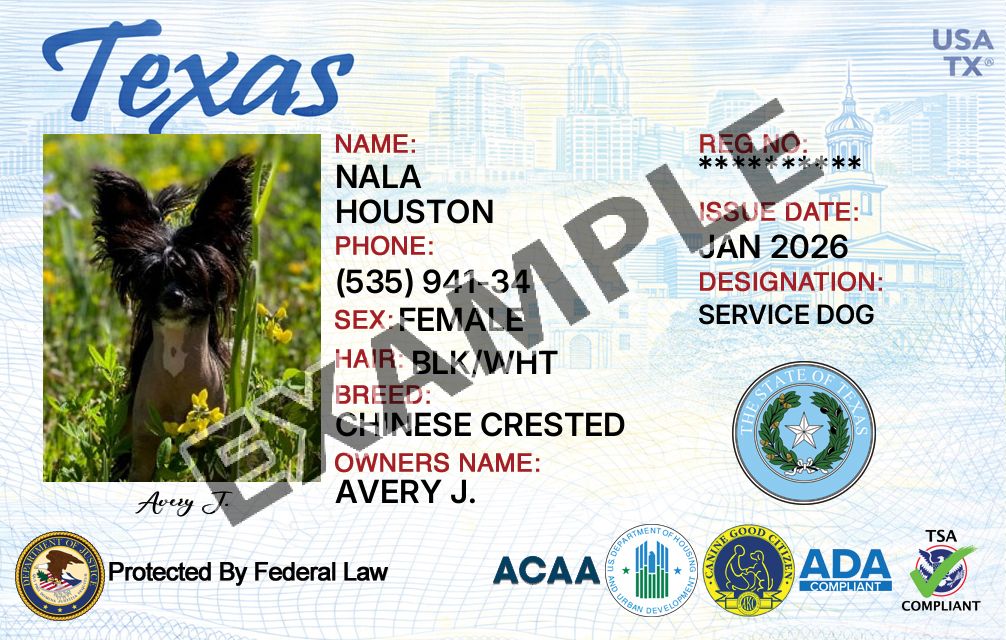
A dog license is not the same as service dog status
A local dog license in Hill County, Texas is a city or local registration requirement tied to rabies compliance and animal ordinances. It does not determine whether your dog is a service animal.
What qualifies as a service dog (general standard)
Service dogs are generally defined by being individually trained to do work or perform tasks for a person with a disability. Examples include guiding a person who is blind, alerting to seizures, or retrieving items for a mobility impairment. Service dog rights usually depend on the dog’s training and the handler’s disability-related need—not on a purchased certificate, vest, or online registration.
Do service dogs still need rabies vaccination and local licensing?
In most jurisdictions, service dogs must still follow public health rules such as rabies vaccination requirements, and may still be subject to local licensing rules where applicable. If you are unsure how your city applies licensing to service animals, contact your local City Hall/City Clerk for the rule that applies at your address.
Emotional Support Animal Rules in Hill County, Texas
ESAs are not the same as service dogs
An emotional support animal (ESA) provides comfort by presence, but is not necessarily trained to perform specific tasks. That distinction matters because service dog public-access rights and ESA accommodations are not the same.
ESAs and local dog licensing
Whether your dog is a pet, ESA, or service dog, local governments can still enforce rabies vaccination rules and (where applicable) city licensing rules. So if you are trying to determine where to register a dog in Hill County, Texas and your dog is an ESA, you should generally follow the same local licensing steps as any other dog owner, unless your city provides a specific exemption in its ordinance.
Housing vs. public access (why it matters)
ESA-related protections are most commonly discussed in the context of housing accommodations. Public access rules for businesses and government buildings typically treat service animals differently than ESAs. For questions about a dog license or rabies enforcement, focus on your local animal services office or City Hall rather than an ESA registry.
Frequently Asked Questions
Disclaimer
Licensing requirements and office locations may change. Residents should verify details with their local animal services office within Hill County, Texas.